

Office of International Affairs: 2020-21 in Review
Land Acknowledgment: McMaster University recognizes and acknowledges that it is located on the traditional territories of the Mississauga and Haudenosaunee nations, and within the lands protected by the Dish With One Spoon wampum agreement.
Vice Provost, International Affairs
VICE PROVOST’S MESSAGE
It is with great pleasure that I invite you to explore our many activities and accomplishments over the past year. The Review is a reflection of the unwavering dedication and commitment of OIA’s staff and many members of the McMaster community to enhancing McMaster’s international profile, even under the most difficult circumstances. We enter 2022 with the firm resolve to continue to foster global citizenship within the McMaster community, to maintain and strengthen our existing international partnerships and to build new ones in the spirit of mutual respect and understanding. We hope you will join us in this endeavour.
Mission and Activities
McMaster University is an institution that aspires to be increasingly global in its partnerships and impact. The Office of International Affairs plays a key role in realizing this aspiration through the development of strategies and execution of plans in support of the McMaster Model for Global Engagement and Institutional Priorities and Strategic Framework (2021-2024). These include foci on research collaborations, strengthening international institutional linkages in teaching and learning and building strategic alliances with the international community.

Information Box Group
The Office of International Affairs
Promotes McMaster’s international profile
Promotes McMaster’s international profile and presence around the world and strengthens engagement with key regions, countries, and institutions.
Builds strategic global relationships
Facilitates international collaborations and helps build strategic global relationships responsive to the needs and priorities of the University deans, faculty, researchers, and central administration.
Participates in national and global alliances and networks
Participates in national and global alliances and networks, focused on issues of local, national, and global relevance, and shares information and opportunities for further engagement with the relevant deans, faculty, researchers, student groups and staff.
Facilitates international visits and delegations
Manages and facilitates international institutional visits and delegations, advising on organization and protocol for international visits and missions, and coordinating the hosting of guests, including scholars, government representatives and dignitaries.
Provides strategic advice and guidance
Provides strategic advice and guidance for global partnership agreements and partnership renewals.
Collaborates on strategic global engagement activities
Leads and collaborates on strategic global engagement projects and activities in concert with McMaster faculty, students, staff, and alumni to foster global citizenship and address pressing global issues with local and global impact.
Assists McMaster faculty and staff
Assists McMaster faculty and staff with global engagement initiatives locally, virtually, and internationally, including international conferences and events, working closely with business units across campus.
Facilitates international collaboration
Facilitates international collaboration opportunities that benefit the world and our partners.
Delivers summer programs
Delivers annual summer programs for international students.
Global Reputation and Ranking
McMaster University has moved up three positions to rank 14th globally and is placed 3rd in Canada in the Times Higher Education (THE) Universities Impact Ranking which recognizes the actions universities are taking in their own countries and on a global scale to address the United Nations Sustainable Development Goals (SDGs). More than 1,200 universities from 98 countries submitted data for the 2021 rankings, compared to approximately 850 participants last year.
In the THE World University Rankings and the Academic Ranking of World Universities (ARWU), McMaster consistently ranks among the top 100 universities globally.

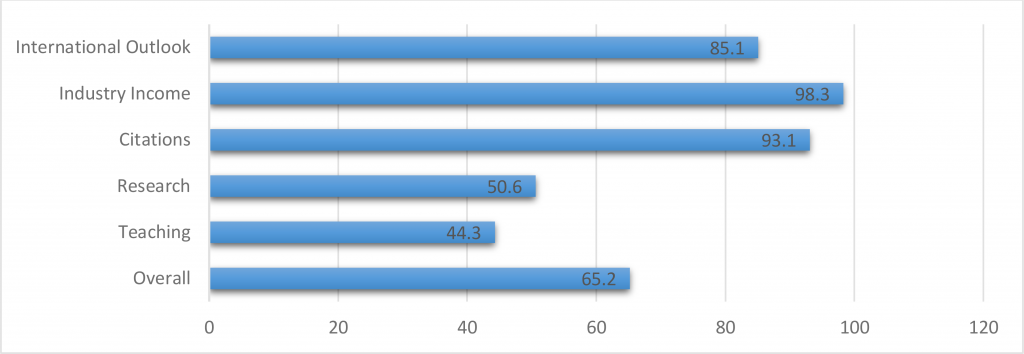
Times Higher Education (THE) World University Ranking 2022
This chart shows a breakdown of McMaster’s score in the Times Higher Education (THE) World University Rankings for 2022 grouped into five categories of performance indicators. Of note, McMaster’s score for the ‘International Outlook’ category increased from 83.8 in 2021 to 85.1 for 2022.
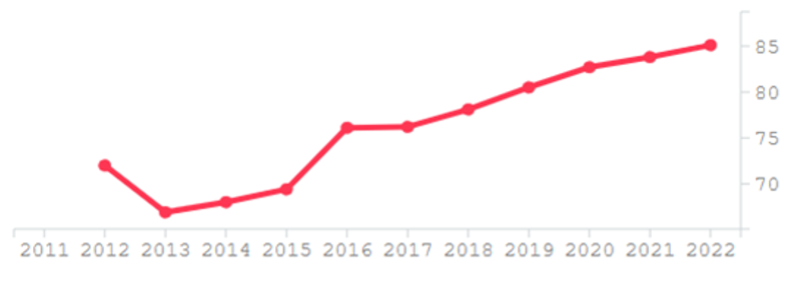
Breakdown via year: THE World University Ranking, International Outlook category
McMaster’s THE World University Ranking score for the International Outlook category has trended up from 2013 to 2022. This trend is positively impacted by an increase in international students, faculty, and international collaborations.
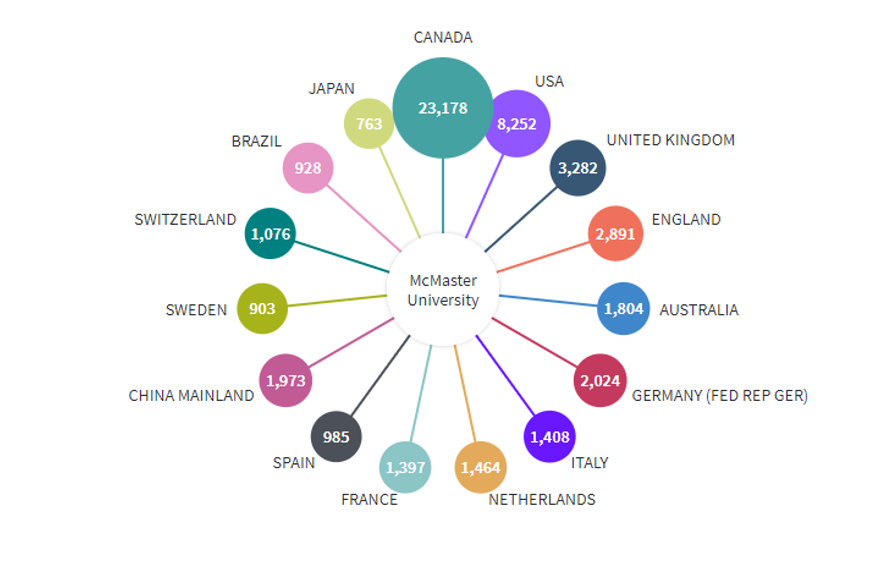
Top 15: McMaster faculties’ joint research publications around the world
McMaster University researchers and faculty are collaborating and building partnerships with researchers and faculty at key universities world-wide. OIA works closely with McMaster faculty to facilitate such partnership building.
Ethics, Integrity and Social Awareness
The McMaster Global Engagement Strategy describes McMaster’s Mission in the global arena as “…engaging with the global community guided by principles of integrity, reciprocity, reflexivity, sustainability and transformation”. It is our intent to “foster global citizenship among students, faculty, staff, and administration through institutional participation in global initiatives, including international partnerships in support of research, academic excellence and value creation [and to] integrate global awareness in the students’ learning and co-curricular experiences, both on campus and through international mobility”.

Information Box Group
These endeavours are reflected in and supported by our active participation in international organizations that concern themselves with issues of integrity, environmental and social awareness and responsibility, and sustainability, with increasing orientation towards the UN Sustainable Development Goals (SDGs). Among them are:

Information Box Group
We are also an active participant in the recently established cluster initiative “Higher Education and Research for Sustainable Development” of the International Association of Universities (IAU), focussing specifically on SDG 1 (No Poverty) and SDG 5 (Gender Equality).
Information Box Group
Further, the Office of International Affairs is mindful to facilitate opportunities for these values and principles to be learned and championed by our students. For example, in 2020/21 the Office of International Affair’s support was instrumental in coordinating and showcasing McMaster’s student talent in global competitions such as the 3-Minute-Thesis (3MT), the World’s Challenge Challenge, the U21/PwC Challenge and the U21 RISE Competition.
Information Box Group
Further, a strong McMaster cohort participated in the inaugural U21 Global Citizenship program, a sustainably themed virtual exchange experience, bringing together over 2000 students from U21 member institutions, synchronously and asynchronously around the UN SDGs.
The Office of International Affairs supports global citizenship among our student groups, such as the McMaster Model United Nations (MacMun) and the World University Service of Canada (WUSC). The Office of International Affairs sponsors both the MacMun and WUSC conferences and is collaborating with these groups on events and initiatives as well as enhancing awareness of their activities and opportunities for involvement through the McMaster Global Hub

Strategic Initiatives
The Office of International Affairs leads, contributes to, and collaborates on strategic projects and initiatives that support McMaster’s global engagement strategy and strategic plan.

The International Initiatives Micro Fund (IIMF)
The International Initiatives Micro Fund (IIMF) has provided critical seed funding to initiate the development of international partnerships and projects across the University. Since its inception in February 2015, the IIMF has supported close to 50 initiatives, with a total investment of more than $250,000. The IIMF will be relaunched in 2021/22 with new funding.
The McMaster Global Hub
The McMaster Global Hub is a central, collaborative, information portal that aims to connect the communities we serve to McMaster University’s international programs, opportunities, news and events (https://global.mcmaster.ca/). Enhancements made to the Hub in 2020/21 are as follows:
- Integration of the Office of International Affairs web page with the McMaster Global Hub
- Updates to the menu and new links to relevant resources (e.g. Travel and Safety)
McMaster Global – Annual Showcase of Global Engagement
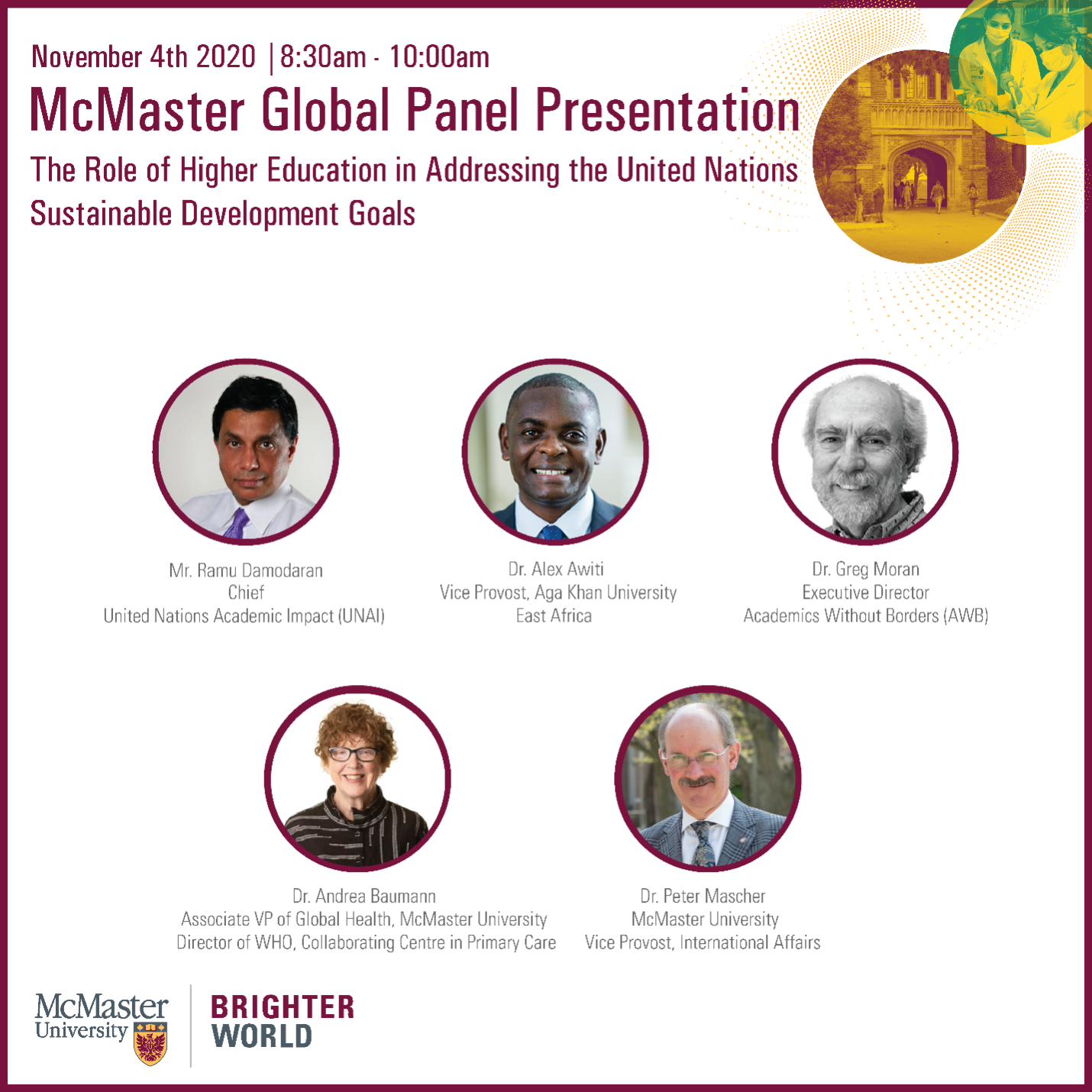
The 3rd annual McMaster Global events showcase was hosted for the first time as a virtual conference from November 2nd to 13th, 2020. It aimed to increase global engagement of McMaster students, faculty, staff and alumni by hosting lectures, panel discussions, information sessions and cultural celebrations that highlight the breadth of our collective commitment to global engagement, address global issues and foster global citizenship. It also provided a forum for the Annual Global Engagement Town Hall Update.
Events were categorized by the United Nations Sustainable Development Goals (SDGs) and all events were submitted using the new events form submission process in the McMaster Global Hub. Highlights included a series of transdisciplinary panel discussions focused on global water issues such as water management and supply for Indigenous communities, water and health (including COVID susceptibility and prevention) and transboundary/water governance as well as international panel discussions on “The Role of Universities in Addressing the UN SDGs”, “Access to Higher Education: A Shared Vision in the Caribbean Region”, “Seeing Themselves: Race, Education and Black Life in Canada”, and “Combatting Modern Slavery: Why Labour Governance is Failing and What we Can do about it”.
The 4th annual McMaster Global events showcase was hosted for from November 1st to 12th, 2021. Faculties, departments, research centres, student organizations and administrative units hosted virtual events and activities to celebrate, including International Education Week and Global Entrepreneurship Week activities. Organized by the Office of International Affairs in collaboration with the Student Success Centre, McMaster Global 2021 highlighted cross-campus initiatives and activities that offer diverse perspectives on global issues. McMaster Global 2021 schedule of events.

Fall 2021 valedictorian, Faculty of Social Sciences
McMaster Global – A student experience
“The McMaster Global Virtual Showcase absolutely changed the way I perceived global health and our community. I learned how important community truly is to enhance the health of all and especially through launching the UN75 event showcase on my podcast: The Global Health Collective. I had the chance to interview amazing professors, and health professional to share their global work with my audience. It was an opportunity to find motivation and courage. The McMaster Global events illuminate our community, the resources, and the up-and-coming plans that various organizations have.”
Expandable List
United Nations 75th Anniversary Dialogue
As part of a 75th Anniversary United Nations global conversation on building a better future for all, the Office of International Affairs led, organized, and facilitated collaboration between McMaster students, staff, and faculty on a series of interactive UN75 virtual dialogues:
The ‘Investing in Health for an Equitable Future’ hosted by the McMaster Model for United Nations (MacMUN), the Global Health Office (GHO) and the Office of International Affairs (OIA) included a panel discussion focused on SDG 3: to ensure healthy lives and promote well-being for all at all ages. The panel discussion included global changemakers Dr. Andrea Baumann, (Associate Vice-President of Global Health, Director of the WHO Collaborating Centre in Primary Care and Health Human Resources), Dr. Peter Singer (Special Advisor to the Director General of the World Health Organization) and Dr Bonnie Ibhawoh (Senator William McMaster Chair in Global Human Rights and Chair, United Nations Expert Mechanism on the Right to Development in the Office of the United Nations). Students had the opportunity to engage in discussion through various interactive platforms such as polling, surveys, and a Q&A throughout the session. The ideas and thoughts shared during the event were compiled into a report submitted to the United Nations: https://dailynews.mcmaster.ca/articles/equity-is-in-our-hands/
‘Climate Crisis – A War We Can Win,’ was hosted in collaboration with the Global Health Office and the student-led Global Collective Podcast. The podcast dialogue featured Josipa Petrunic, the founder of the Canadian Urban Transit Research & Innovation Consortium, a non-profit organization dedicated to zero-carbon mobility and transportation across Canada: https://dailynews.mcmaster.ca/articles/tackling-global-problems-through-dialogue-and-discussion/
‘Be the Change’, hosted by the McMaster Student Success Center was a social media campaign stimulating dialogue about the Sustainable Development Goals with students via social media channels. The campaign received support from the Office of International Affairs, the Academic Sustainability Programs Office, as well as several faculty supporters, including Dr. Bonny Ibhawoh, Dr. Altaf Arain, Dr. Jim Cotton, and Dr. Sonya de Laat.
International Partnerships and Networks
The Office of International Affairs continues to develop and maintain strong partnerships with national and international higher education organizations such as Universities Canada (UC), the Canadian Bureau of International Education (CBIE), the Council of Ontario Universities (COU), The U15 and the Ontario Association of International Education (OAIE), the International Association of Universities (IAU), the Inter-American Organization for Higher Education (IOHE), the Institute of International Education (IIE), the Association of Commonwealth Universities (ACU), the Association of International Education Administrators (AIEA), the Asia Pacific Association of International Education (APAIE), and the Universitas21 Network of Research Universities (U21).
Information Box Group
Highlights:
McMaster University entered its fourth year as a member of Universitas 21 (U21), a prestigious global network of 27 research-intensive universities from 17 countries focused on collaboration and global knowledge exchange. McMaster continues to be an active participant in various programs organized by the Directorate at the University of Birmingham.
The Office of International Affairs continues to engage and develop a strong presence in Latin America and the Caribbean. McMaster recently became a member of CALDO which is made up of 10, U15 Institutions focusing on building research partnerships, collaborative program development at the graduate level, and seeking to recruit graduate students that are funded by Government scholarship programs.
Through the Office of International Affairs and contributing faculty members new partnerships are encouraged and established based on strong research ties, strategic but mutually beneficial opportunities, and a clear pathway for graduate students to gain international experience. Examples of collaborations that have raised McMaster’s global recognition include those with U21 members, the French National Center for Scientific Research (CNRS) and the Pasteur Institute. Opportunities afforded through the Erasmus+ program and the German Academic Exchange Service (DAAD) have allowed our faculty and graduate students to engage in research-based training in EU countries.
Several of the ASEAN countries – most notably, Malaysia, Vietnam, and Indonesia – have embarked on ambitious agendas to improve their post-secondary education system, including building a competitive R&D capacity. McMaster’s presence in the region is important and sought after. There also are significant opportunities for capacity building in the region.
Through the efforts of the Office of International Affairs, Graduate Studies and various research teams, virtual research internships have been established in response to the current travel restrictions and lockdowns. Virtual Research Internships will be maintained as the benefits of such an initiative have clearly been realized by all participating faculty. We envision virtual research internships to complement on-campus research internships when travel restrictions, and regional lockdowns are lifted.
Expandable List
International Mobility
In lieu of suspended study abroad and exchange programs due to COVID-19 travel restrictions and as a priority need to start facilitating broader, equitable access to intercultural education and global experiences for all students, the Office of International Affairs is supporting several new international mobility initiatives:
‘A Building Block to Global Engagement’, is an Outbound Mobility Innovation Project funded by the Government of Canada through Universities Canada and is coordinated by the Office of International Affairs in collaboration with the Student Success Center (SSC), Dr. Lydia Kapiriri (Department of Health Aging & Society), and the Faculty of Social Sciences. The output of this phased initiative is a university-wide, inter-disciplinary global online preparatory course for all outbound mobility participants and motivated on-campus learners to develop the knowledge and skills necessary to thrive as responsible global citizens.
The McMaster African and Caribbean Leadership Exchange (MACLeads) is a collaborative project funded by the government of Canada through the Global Skills Opportunity, Universities Canada. This developing initiative will provide high impact leadership training that opens minds, doors, and opportunities for young, emerging and under-represented Canadian leaders to tackle global challenges, especially in the Global South (Africa and the Caribbean). MACLeads will provide diverse undergraduate students with experiential learning opportunities through work/study placements in the Global South. Building on existing McMaster initiatives, MACLeads activities will include international work/study placements, wrap-around leadership, mentorship and global citizenship training modules, and a virtual learning platform. The proposed program will provide an innovative and scalable model that supports participation of students who traditionally experience barriers accessing global exchange opportunities.
Developing Skilled Future Leaders in Strengthening Health and Social Systems is a project funded by the government of Canada through the Global Skills Opportunity, Universities Canada. This developing initiative will enable emerging leaders within McMaster’s undergraduate community to build knowledge and skills to support health- and social-system strengthening internationally. McMaster Health Forum’s programs will be leveraged to support skills development in policy, political and systems analysis, evidence synthesis, and stakeholder engagement, while building on experience with student mentorship, leadership development and facilitating international exchange. The project will leverage the McMaster Health Forum’s extensive network of international partners (e.g., 57 global members of the COVID-19 Evidence Network to support Decision-making (COVID-END) and those involved in the Global Commission on Evidence to Address Societal Challenges) to support meaningful international experiences.
The Collaborative Online International Learning (COIL) pilot project is conducted in collaboration with the University of Göttingen (Germany) and the Faculty of Social Sciences. The pilot COIL initiative provides participating students and faculty with access to virtual global engagement opportunities, including online collaborative curricular projects with an emphasis on intercultural communication and global citizenship.
The pilot COIL project and our new international mobility opportunities support McMaster’s EDI Strategy’s Action Objective #3: Inclusivity and Interdisciplinarity in Curricula and Scholarship by facilitating broader access to intercultural education and global experiences for all students and providing our faculty with the opportunity to deepen partnerships and collaboration around the world.
Host Institution for Academics Without Borders
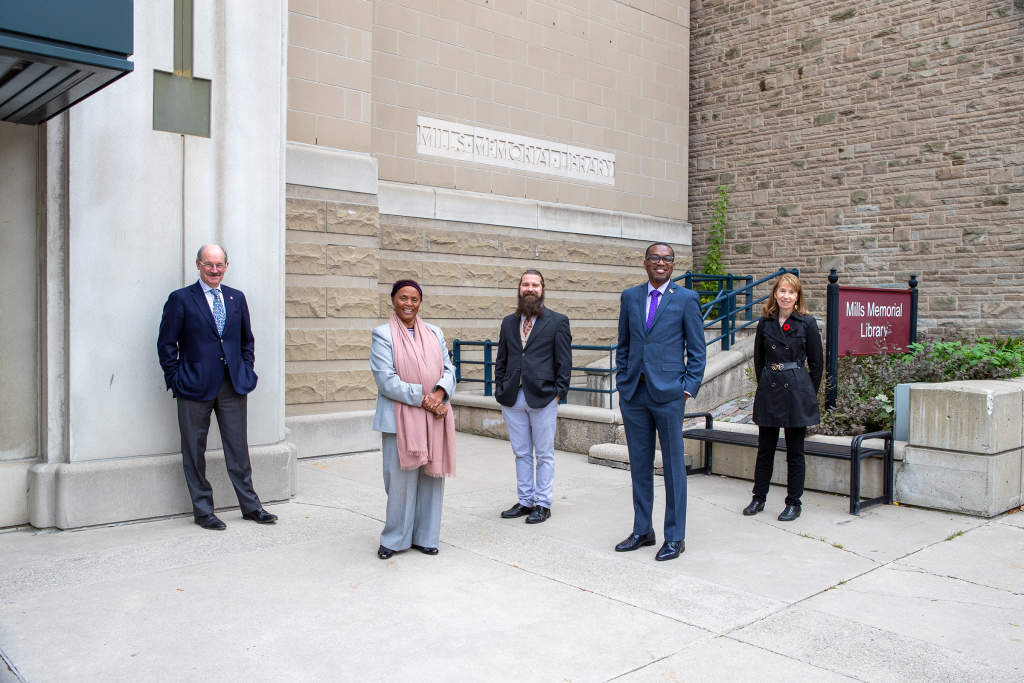
McMaster University is the host institution for Academics Without Borders (AWB), a virtual, volunteer-driven NGO that connects academics in the developed world with colleagues and universities in developing countries. McMaster University has a strong record of partnerships in the developing world, including the ongoing engagement of its faculty and staff in AWB projects. Working closely with AWB, McMaster is supporting capacity-building in higher education as a means to foster greater prosperity, equity and well-being for all. Through this partnership and the support of the Office of International Affairs, McMaster affirms its commitment to fostering global citizenship on and beyond campus and demonstrates an active orientation to addressing the challenges of the world.
Canadian Bureau for International Education (CBIE) Regional Conference
The Office of International Affairs planned and hosted the first virtual Canadian Bureau of International Education (CBIE) Ontario Regional Conference, ‘Opportunities for International Higher Education: Keeping the Future Human’ from June 7th – 11th 2021. The conference was attended virtually by 234 international education leaders, scholars, students, and practitioners from across Canada and around the world. Highlights included several expert international panel discussions exploring the future of internationalization and global engagement in light of COVID-19, equity and inclusion in internationalization and the role of UN SDGs in global engagement. The Office of International Affairs is thankful for the partnership and contributions of the Canadian Bureau of International Education (CBIE) McMaster’s Student Success Centre, University Technology Services (UTS), Media Production Services (MPS) and all the volunteer McMaster staff and student session hosts.

The Future of Internationalization and Global Engagement
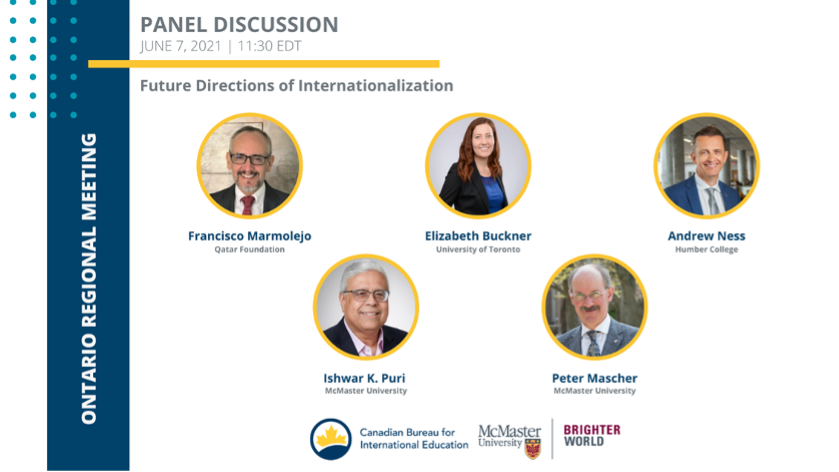
Panel Description: What are the short and long-term impacts of the COVID-19 pandemic on internationalization for higher education institutions (HEIs)? What current and emergent challenges and opportunities will shape the evolution of global engagement in HEIs? Join keynote speaker, Francisco Marmolejo, President of Higher Education, Qatar Foundation, and our distinguished panel of experts for insightful, thought-provoking presentations, moderated dialogue, and Q&A on the current and future state of internationalization.
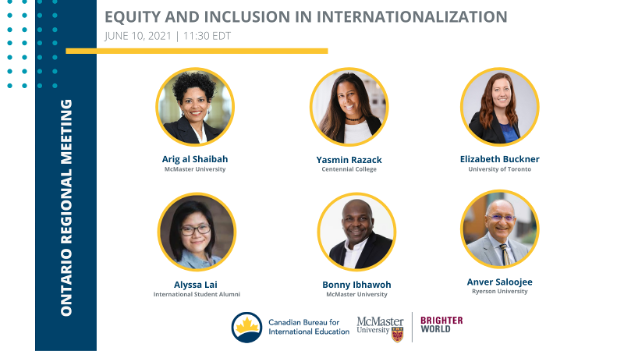
Equity and Inclusion in Internationalization
Panel Description: What is ‘Inclusive Internationalization’ and why is it important? How can new and emerging leaders in international education enhance equity, diversity, and inclusion goals while meeting internationalization objectives? How do we bring greater acknowledgement to the experience of racialized international students, and ensure a welcoming and supportive environment amidst the challenges amplified by COVID-19, including the increase of anti-Asian racism? How do we ensure more inclusive exchange experiences for student groups who have been less represented in international mobility programs such as indigenous, racialized students, students with disability, students from lower socio-economic backgrounds, and mature students? Can Internationalization at Home (IaH) address gaps left by the traditional study abroad? This panel discussion will explore the intersection of internationalization with diversity, equity, and inclusion (EDI). Join our esteemed panellists in exploring this critical topic, followed by a moderated dialogue and Q&A
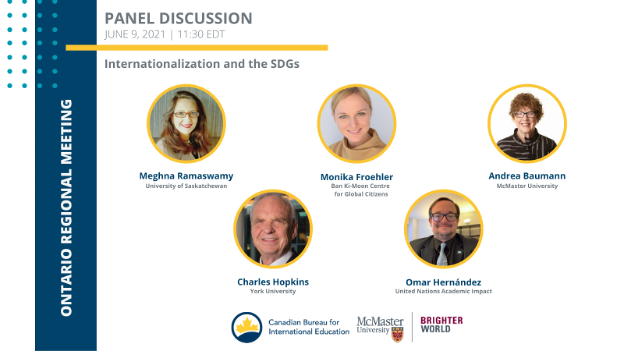
Internationalization and the SDGs
Panel description: The Sustainable Development Goals (SDGs), also known as the Global Goals, were adopted by all United Nations Member States in 2015 as a universal call to action to end poverty, protect the planet and ensure that all people enjoy peace and prosperity by 2030. Today, the global goals are an increasingly popular framework and set of principles used by higher education institutions (HEIs) to inform their missions and transform aspirational goals into measurable and sustainable impacts. What is the role of HEIs, and, international offices and programs, in advancing the UN 2030 agenda? What are the emerging practices to embed the UN SDGs into internationalization in higher education, and how are universities and colleges adopting and mobilizing the SDGs as part of their strategies? Join our distinguished panel of experts who will exchange ideas and experiences on this important topic, followed by a moderated discussion and Q&A.
More Strategic Initiatives
Global Mobility Software Project Learn More
The Office of International Affairs in collaboration with Student Affairs/Student Success Centre is sponsoring a priority strategic project to automate and streamline mobility and international partnership management processes.
McMaster Global Community of Practice Learn More
The Office of International Affairs is collaborating with International Student Services on the development and launch of a McMaster Global Community of Practice.
Sharing Sustainability: A How-To for Higher Education Learn More
In 2020/21 McMaster launched Sharing Sustainability: A How-To for Higher Education, a collaboration of the McMaster Global Health Office, Communications and Public Affairs, the Office of Institutional Research and Analysis (IRA), the Office of International Affairs and the UN SDG Rankings Committee.
Global Competitions Learn More
Of note there has been an increase student engagement and participation in U21 RISE, PwC Innovation Challenge and ‘World’s Challenge Challenge’ competitions.
Summer Programs and ESL Learn More
COVID-related restrictions made it necessary to move our summer programs from the traditional in-person to virtual programs. The virtual research internship program involved 17 students from the University of Science and Technology of China (USTC) and researchers from the Faculties of Science and Engineering. In addition, over 70 students were enrolled in specialized thematically focused programs.
SDSN Canada Membership Learn More
In close collaboration with McMaster’s Academic Sustainability Office, the Office of International Affairs is the central lead for McMaster University’s membership in the Sustainable Development Solutions Network (SDSN).
Response to the Crisis in Afghanistan
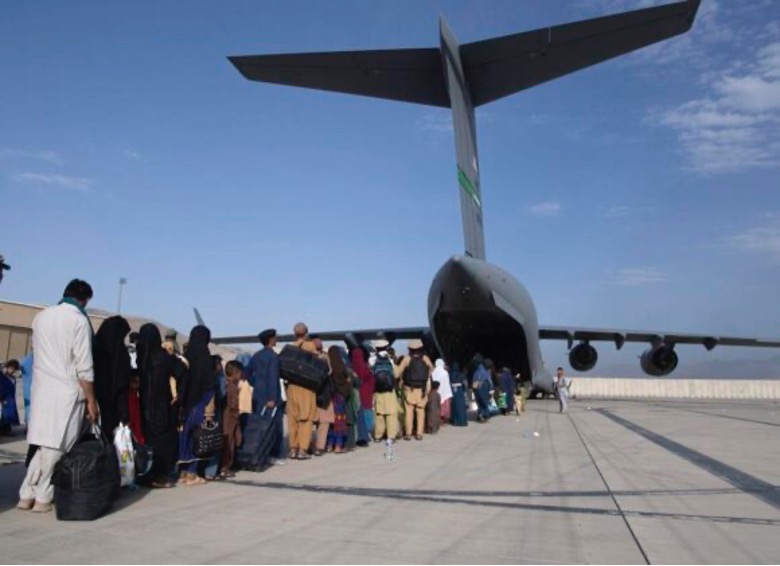
In the summer of 2021 McMaster faculty, staff and students of the Gender and Social Justice graduate program released a statement of concern about the threats that women and members of the LGBTQ+ community in Afghanistan are facing to their human rights, physical safety, and lives, in the wake of the Taliban’s return to power.
GLOBAL ENGAGEMENT STRATEGY UPDATE
In 2021/22 updating the McMaster Model for Global Engagement strategy is a priority initiative for the Office of International Affairs in consultation with the McMaster University community. The goal is to keep elements that remain a priority for McMaster while also making key updates to closely align the strategy with the institutional priorities embedded in McMaster’s new Strategic Plan. Consultations with key stakeholders and the McMaster community will take place in 2022.
